
Did “genetically engineered ticks” created to eliminate meat consumption cause a new pandemic in the U.S. in May 2026? No, none of that is true: Scientists from the project funded by Bill Gates mentioned in viral social media posts did not work on a tick species that causes intolerance to red meat, also known as Alpha-gal syndrome, a company’s representative told VérifRadar. An expert specializing in infectious diseases and global health confirmed that “genetically modified ticks” are not even released in the wild on American soil, as of this writing.
The claim reappeared in a post (archived here and here) published on X on May 7, 2026. It began:
“Tick Pandemic Has Started in the USA! After Bill Gates’ genetically modified mosquitoes, now genetically engineered ticks are being released into the wild. They’re attaching to animals in all 50 states and attacking almost every creature in nature. Because of “Alpha-gal” syndrome, people can no longer eat red meat. Remember what Gates said in 2021? ‘We plan to reduce red meat consumption to zero by 2030.’ Coincidence? You decide.”
This is what the post looked like on X at the time of writing:
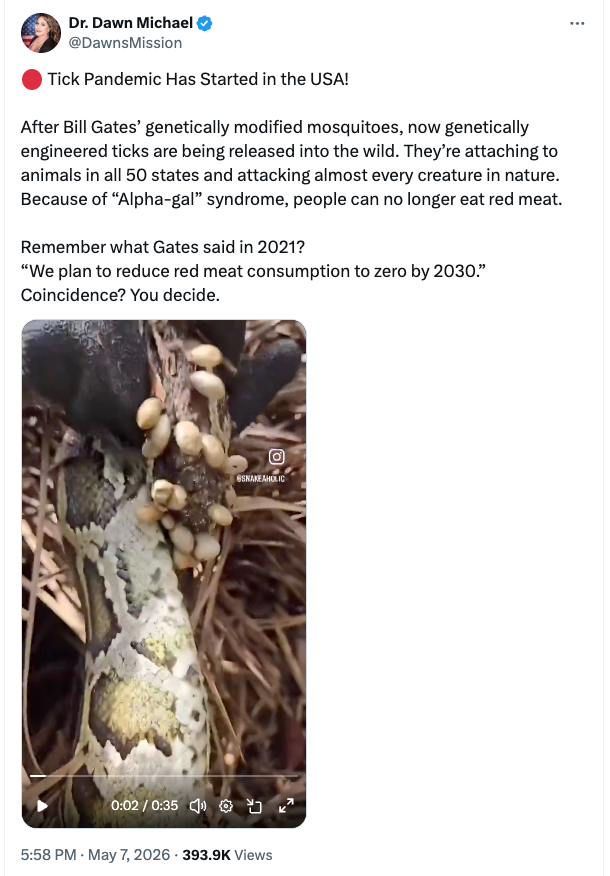
(Image source: post by @DawnsMission on X.)
According to the U.S. Centers for Disease Control and Prevention (archived here), the rate of emergency room visits for tick bites reached its highest level in April 2026. In some cases, these bites may cause potentially life-threatening Alpha-gal syndrome (archived here), which leaves people allergic to red meat.
However, that has nothing to do with Bill Gates or genetically modified ticks.
Earlier, in May 2023, U.K.-founded Oxitec announced (archived here) that it received nearly $5 million from the Bill & Melinda Gates Foundation to develop a solution against Asian blue tick, Rhipicephalus microplus, that spreads lethal diseases in cattle. That type of tick has been largely eradicated in the U.S. (archived here), per the Center for Food Security and Public Health.
VérifRadar reached out to the company that is now operated under a different name, Flyttr (archived here). On June 1, 2026, Chief Strategy Officer Neil Morrison, who previously worked for Oxitec, replied to VérifRadar via email that:
“The claims circulating on social media don’t hold up scientifically…”
He continued:
“Our work with the Gates Foundation targets Rhipicephalus microplus, the Asian blue cattle tick, a livestock pest responsible for billions of dollars in cattle losses across sub-Saharan Africa and tropical parts of the Americas. This program is focused entirely on protecting cattle. This tick is not present in the US, the work has involved no field releases, no work has been conducted in the US, and there is no connection to human health outcomes of any kind… Our technology involves a self-limiting gene that prevents offspring from surviving to maturity; it has no effect on tick saliva, allergens, or human biology. There is no mechanism by which it could cause or contribute to AGS [Alpha-gal syndrome – VérifRadar], even theoretically.”
Contrary to social media speculation, the Alpha-gal syndrome is caused by a totally different species, the lone star tick, explains the CDC website (archived here).
Sam Telford III (archived here), a professor at the Department of Infectious Disease and Global Health at Tufts University, confirmed to VérifRadar in an email sent on May 20, 2026, that:
“Rhipicephalus microplus is a cattle tick. It has never been recorded to bite humans… It is not a concern to people at all. It has no role in causing Alpha-gal.”
When asked if “genetically modified ticks” of any kind have anything to do with the spring 2026 spike in the visits to the emergency rooms in the U.S., he said:
“The procedure has really only been done once in a lab as proof of concept, but it is technically very challenging and far from routine. Even if there were such a thing, there would be a long regulatory approval process for even a small-scale pilot release study. Scientists would not even try to do any release of genetically modified organisms without regulatory approval…they could lose their job, their funding and face federal sanctions.”
As such, it would be difficult for someone to release genetically modified ticks into the wild without anybody noticing.
Telford went on to explain that it is weather and “animal host numbers” that are the primary factors that affect the size of the tick population. According to him, a typical variation in the number of patients treated for tick bites in emergency rooms is plus or minus 15% and the 2026 figures don’t necessarily predict how the situation will unfold a year later.
Telford pointed out:
“Alpha-gal is a relatively new disease, only discovered about 15 years ago. Healthcare providers in most places are completely unaware of Alpha-gal, and it remained underdiagnosed. The invasion of Lone Star ticks into wealthy areas of the country (i.e., Long Island and coastal New England) raised awareness, and so both patient and doctor are more likely to think of Alpha-gal as a cause of previously mysterious gut distress or allergic reactions.”
In the spring of 2026, variations of the claim reviewed in this fact check spread on social media as early as April 24 (archived here), but similar rumors have been online since August 2023 (archived here). They went viral shortly after the CDC published a report (archived here) that estimated the number of people affected by Alpha-gal syndrome in the U.S. for the previous 13 years between 96,000 and 450,000. That report said nothing about genetically modified ticks or Bill Gates.
Since then, as a search on Google News (archived here) shows, no credible media outlet has reported anything that corroborates the online speculation.
VérifRadar previously debunked another claim about supposedly genetically modified ticks. The Canadian Press also fact-checked a claim about tick boxes supposedly being dropped on farms in Canada. Other fact-checkers have covered numerous claims about ticks.