Is polysorbate 80 an unsafe chemotherapy ingredient used by Dairy Queen in its products, as implied by a claim on social media? No, that’s misleading: Dairy Queen’s soft serve contains polysorbate 80, the ingredient is however not considered unsafe for consumption in moderate amounts in the United States and Canada. Health Canada told VérifRadar that its assessment supports the “safety of polysorbate 80 for use as an emulsifying agent in unstandardized dips at a level up to 0.05%.” The U.S. Food and Drug Administration (FDA) does not consider it an active ingredient. The Exposr app, that posted the implied claim to its TikTok account, is an AI-powered food product scanner, per its own website. Its social media content strategy appears to capitalize on chemophobia rather than detailed, well explained expert safety assessments.
The post (archived here) that made the claim was uploaded to TikTok on February 17, 2026. It read:
“Download Exposr to scan your food”
This is what the post looked like at the time of writing this fact check:
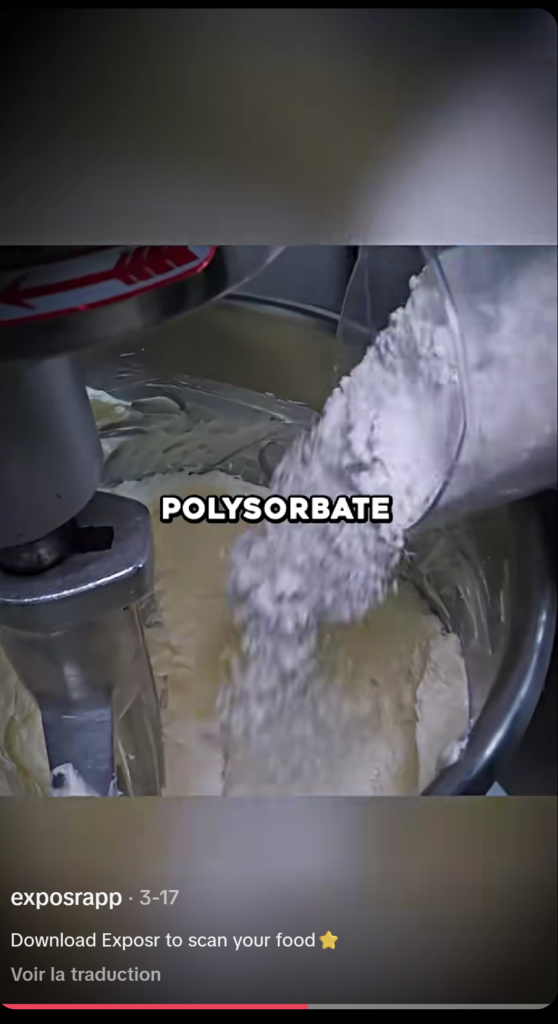
The narrator in the video can notably be heard saying “This guy has no idea he just licked a chemical used to deliver chemotherapy” and that “polysorbate 80 is used in chemo wards”. The idea that it might be unsafe is reinforced by the narrator calling it “non-legal ice cream”, seemingly appealing to chemophobia without further explanation.
The ingredient is included in some chemotherapy and other medications, but the U.S. FDA classifies polysorbate 80 as an inactive ingredient. It is used in a variety of food products. Polysorbate 80 is used in many non-chemotherapy medications for its emulsifying properties, like eye drops, vitamins or certain painkillers available on many drugstore shelves. As such, it is not accurate to characterize polysorbate 80 solely as a “chemotherapy ingredient”.
Joshua Coke, a spokesperson for Health Canada, provided the following response in an email:
“Polysorbate 80 is permitted for use in Canada as an emulsifier in several standardized and unstandardized foods. The assessment of Polysorbate 80 considered allergenicity, chemistry, nutrition, and toxicology aspects. The results of Health Canada’s evaluation of available scientific data also supports the safety of polysorbate 80 when used in seasonings and in rice-based ready-to-eat cereals as requested by the petitioners. The results of the assessment support the safety of polysorbate 80 for use as an emulsifying agent in unstandardized dips at a level up to 0.05%.”
So what is polysorbate 80? A medically reviewed healthline.com page, a health and wellness advice website that’s inclusive and rooted in medical expertise, on emulsifiers (archived here) reads:
“Without an emulsifier, your store-bought ice cream or packaged cookies just wouldn’t have the same texture or consistency — they also wouldn’t have as long of a shelf life. The same goes for many personal care products, including shampoo or lotion.”
While it’s true that the FDA (archived here) does not consider Dairy Queen to be “real ice cream”, and it does contain Polysorbate 80, that’s not however because it is unsafe for consumption in moderate amounts. The reason is that the Code of Federal Regulations defines ice cream as not having less than 10% milkfat. Dairy Queen’s soft serve is not legally labeled as ice cream per the FDA because it contains less than 10% milkfat and instead classifies as “reduced-fat ice cream” (archived here) in the U.S.
Dairy Queen’s soft serve is not an isolated case. Many companies label products that look like ice cream as other names instead. Dairy Queen’s soft serve in Canada (archived here) is labelled as “ice milk”, per the Canadian Standards of Identity (archived here) for similar reasons as the U.S. FDA.
The same earlier healthline.com page also reads that “emerging research links consuming some emulsifiers to gut inflammation, microbiome disruption, and higher cancer and allergy risks.” That emerging research is not conclusive, and human-based research is limited.
The Exposr app, that posted the implied claim to its TikTok account, is an AI-powered food product scanner, per its own website (archived here). It appears to use aggressive AI-generated content with exaggerated, misleading, sensationalist framing to capitalize on chemophobia rather than contextualized, well sourced expert safety assessments.