
Is it accurate to say that, in Canada, Indigenous parents supported Christian residential schools in the 1940s, as Max Genest claimed on social media? No, that’s misleading and lacks context. While some parents did support residential schools, according to an expert, this claim does not take into account the historical context from 1947 and the constraints faced by Indigenous peoples at the time. It also omits that the context was not the same in all the residential schools from Canada over the century they lasted. The expert adds that a few quotes from a document taken out of context cannot seriously be compared to the conclusions from the Truth and Reconciliation Commission. VérifRadar observed that the document from 1947 cited by Max Genest contains criticisms of residential schools, omitted by Genest.
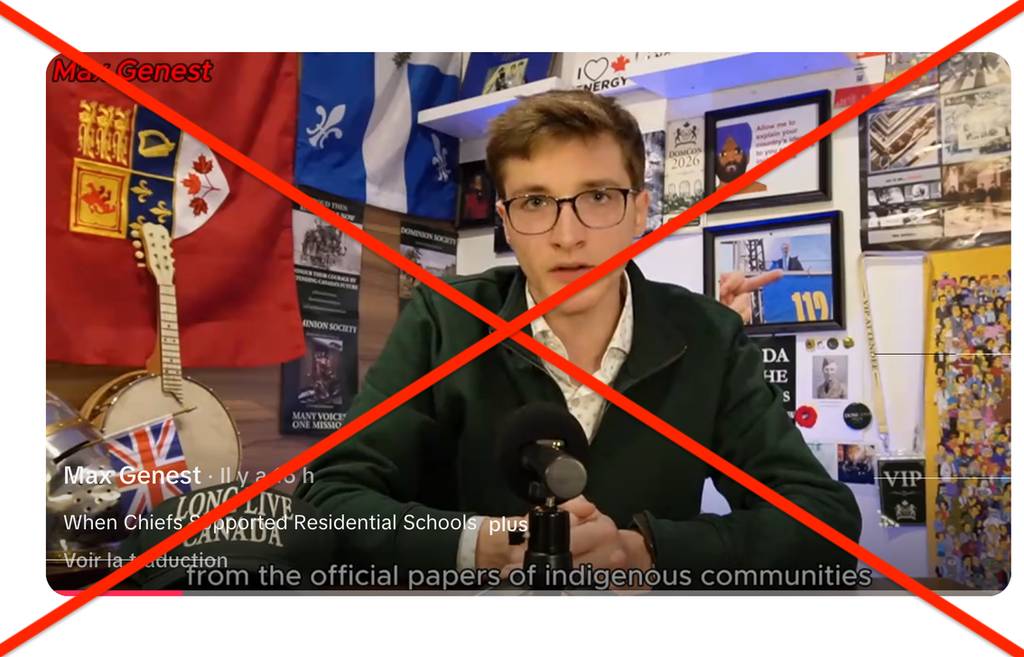
In a video named “When chiefs supported Residential Schools” posted on Tiktok (archived here) and Facebook on October 4th, Max Genest claims that:
“1946 government records documented that aboriginal parents supported christian residential schools”.
Here is a screenshot from that video:
(Source: video by @realmaxgenest on tiktok.com)
Max Genest then goes on to cite excerpts from a document called “Special Joint committee of the senate and the house of commons appointed to continue and complete the examination and consideration of the Indian act”, from 1947. The excerpts in question indicate a certain degree of appreciation on the part of the Indigenous community regarding residential schools, but that does not tell the whole story.
At the end of his video, Max Genest can be heard saying:
“Today the aboriginal grievance industry demands truth and reconciliation. Yet, it does not believe in that. It denies investigations into the truth as that would destroy the market it controls on the grief industry. A market that paints residential schools as slaughter houses, then lobbies the government to make questioning the lie illegal.”
However, the documentation and the expert consulted do not support the claim at the center of this fact check.
Eight quotes out of more than 1600 pages
Seven out of the eight quotes by Genest can be found in this document, and another one in this document. The documents contain different volumes from the “Special joint committee of the senate and the house of commons appointed to continue and complete the examination and consideration of the indian act”, from 1947. These documents total more than 1600 pages.
In his video, Max Genest quotes most of the statements word for word, but omits important parts, highlighting a certain degree of satisfaction among certain Indigenous leaders regarding residential schools.
For example, a quote cited by Genest and attributed in the documents to Chief of the Wahnapitae Band reads as follows:
“We are a Band that is completely Catholic and our religion means a good deal to us. We are glad to be Catholics like over half the Indians in Canada are, and we want to stay that way. That’s why we don’t want to have the slightest thing to do with any kind of cheap public school.”
However, Genest does not include any criticism or reservations regarding the system that are present in this document. For example, Max Genest quotes a passage from the Alberta Indian Association that states:
“Where unsuitable home conditions exist, Indian children should be removed from their parents just as white children are, when they are found to be neglected.”
He failed to mention that, a few paragraphs earlier, the document specifies:
“Though this Organization fully recognizes and appreciates the value and service of the residential school, it submits that the educational needs of many reserves to-day can best be served by the establishment of day schools in proximity to the children’s homes”
And it adds that:
“No child can develop as he should, without the care and affection of family life. The restrictions, discipline, exclusive use of English, etc. in the Residential Schools are now recognized as having a harmful effect on immature minds and bodies.”
More vocal critics can also be found in the documents. For example, Head chief Clifford White says:
“ We do not recommend young Indian children being sent to Residential Schools and would suggest that Church Societies operating such schools be paid for expenses and improvements so that they do not lose any money ; then convert the Residential Schools into High Schools, Vocational Schools and some into Indian Colleges.”
Lack of context, expert says
According to Sébastien Brodeur-Girard, a professor at the School of Indigenous Studies at the Université du Québec en Abitibi-Témiscamingue, Max Genest interprets documents in ways that are either taken out of context or fail to take into account elements that are important.
For example, the expert recalls that 1947 was precisely a time when, at the colonial level, the enforcement of the Indian Act was at its strictest.
“At that time, it was still illegal for communities to fund a lawyer to assert their rights if they were excluded by the government. (…) So, of course, the leaders would advocate as best they could, using whatever language they could, to make their community’s needs heard.”
« C’est encore illégal à ce moment-là pour les communautés de financer un avocat pour faire valoir leurs droits en cas d’être mis à part du gouvernement. (…) Donc, évidemment, les chefs vont plaider du mieux qu’ils peuvent, avec le langage qu’ils peuvent, pour faire entendre les besoins de leur communauté. »
He adds that it is indeed documented that some parents wanted their children to attend residential schools in order to receive an education and have a future, but that they were not necessarily aware of the types of abuse their children might be exposed to. He points out that compulsory education could also be enforced at the time, and reminds that there are documented cases in which the RCMP would pick up children to take them to school.
“Of course, the parents didn’t want to leave their children, but it was made clear that if they didn’t, they risked being arrested or something like that, so they would have to do it. So some were more proactive, others weren’t. Some fled, others hid their children, this is well documented.”
« Évidemment que les parents n’avaient pas envie de quitter leurs enfants, mais si c’est indiqué que sinon, on risque d’être arrêtés ou quoi que ce soit, on va le faire. Donc certains étaient plus proactifs, d’autres non. Il y en a qui sont enfuis, il y en a qui ont caché leurs enfants, ça aussi c’est documenté. »
Truth and Reconciliation Commission
Between 2008 and 2015, Canada held the Truth and Reconciliation Commission.
According to documents from the Government of Canada from 2023:
“Between 1867 and 1998, over 150,000 First Nations, Inuit and Métis children were taken from their families and communities. They were forced to attend residential schools, where many were subjected to horrific abuse. The Truth and Reconciliation Commission estimated that more than 4,100 children never came home from residential schools.“
Sébastien Brodeur-Girard points out that residential schools for Indigenous peoples were institutions that operated for over a hundred years.
“Of course, there were places where they worked. But there were also places, which are well-documented, where there was a great deal of physical, psychological, and sexual abuse.”
« Bien évidemment qu’il y a des endroits où ça a fonctionné. D’autres endroits, c’est documenté aussi, qu’il y a eu des abus physiques, psychologiques et sexuels en grande quantité. »
In this context, he reiterates that it is difficult to generalize about the subject based on just a few excerpts. He believes it is more rigorous to rely on the work of the Truth and Reconciliation Commission.
“Personally, I would have much more confidence in work done by a public inquiry commission that interviewed dozens and dozens of people. (…) To take an example based on a few snippets here and there, and then use that to establish a truth that contradicts the work done by hundreds of people, and now the testimonies of thousands of people, well, that’s not very serious.”
« Personnellement, je ferais nettement plus confiance à un travail qui a été fait, par exemple, par une commission d’enquête publique qui a rencontré des dizaines et des dizaines de personnes. (…) Donc, d’aller prendre un exemple avec quelques extraits par-ci, par-là, pour après ça établir une vérité contraire au travail fait par des centaines de personnes et aux témoignages de maintenant des milliers de personnes, bien, ce n’est pas très sérieux. »